PRODUCTION OF (BAR) SOAP, How to Produce Laundry Soap write up.
CHAPTER ONE.
1.1 BACKGROUND OF STUDY.
The extract origins of soap are unknown, Through Roman source claim it dates back to at least 600B.C, when Phoenicians prepared it from goat tallow and wood ash. Soap was also made by the celts, ancient inhabitats of Britain.
Soap was used widely throughout the Roman empire, primarily as medicine. mention of soap as a cleanser does not appear until the second century A.D. by the eighth century, soap was common in france, italy, spain but it was rarely used in the rest of europe until as tate as 17th century.
Manufacture of soap began in England around the end of the 12th century. Soap makers have to pay heavy tax on all the soap they produced, the tax collector locks the lids on soap boiling pans every night to prevent illegal soap manufacture after hours, because of high tax.
The french chemist eugene michel chevreul put the soap-forming process (called is English saponification) into concrete chemical terms in 1823.
In saponification, the animal fat, which is chemically neutral, splits into fatty acids, which react with alkali carbonates to foam soap, leaving glycerin as a by-product.
1.2 SCOPE OF THE STUDY.
The soap produced was compared with others to test its quality and effectiveness. And also, the overall effect of bar soap and detergent on skins, cloth, utensils was dealt with.
(adsbygoogle = window.adsbygoogle || []).push({});
1.3 STATEMENT OF THE PROBLEM.
It was in the regard that we venture into the production of bar soap, with the aims of producing soap that will be of good quality, effective to skins, clothes and utensils, knowing how to produce it and materials being used. It also helps to increase popular awareness of the relationship between cleanliness and health.
1.4 OBJECTIVE OF THE STUDY.
CHAPTER TWO.
2.0 LITERATURE REVIEW.
They noticed the clothes coming clean as they came in contact with the soapy clay oozing down the hill and into the water. they later discovered that this same cleaning substance was formed when animal fat was soaked down through the wood ash and into the clay soil.
Factually, we know that soap has been around for about 2,800years. The earliest known evidence of soap use are babylonian clay cylinders dating from 2800BC containing a soap-like substance. A formula for soap consisting of water, alkali, and cassia oil was written on a babylonian clay tablet around 2200BC.
The Ebers papyrus (Egypt 1550B.C) indicates that ancient Egyptians bathed regular and combined animal and vegetable oil with alkaline salts to create a soap-like substance, Egyptian document mention that soap like was used in the preparation of wool for weaving.
Soap was widely known in the roman empire, weather the Roman learn its use and manufacture from ancient Mediterranean peoples or from the celts, in habitats of Britannia, is not know. Early Romans made soap in the first century A.D from urine to make a soap-like substance.
The urine contained ammonium carbonate which reacted with the oil and fat in wool for partial saponification.
The important of soap for washing and cleaning is apparently not recognized until the 2nd century A.D, The Greek physician Galen mentions it as a medicament and as a means of cleansing the body. previously soap had been used in as medicine.
The writings attribute to the 8th century Arab savant Jabir ibn hay an (Geber) repeatedly mention soap as a cleansing agent. The Arab made the soap from vegetable oils as olive oil or some aromatic oil such as thyme oil.
Arabian soap was perfumed and coloured some of the soaps were liquid and other were hard. they also have special soap for shaving. It was commercially sold for 3Dirham’s (0.3 dinars a piece in 981 AD).
2.1 SOAP IN THE MIDDLE AGES.
In Europe soap production in the middle ages center first at marseilles later at Genoa then at venice. Although some soap manufacture development in Germany, the substance was so little used in a central Europe that a box of soap presented to the duchness of juclich in 1549 caused a sensation.
where it could be skimmed off by the soap-boiler, leaving the excess iye and the impurities to settle out.
2.2 SOAP MAKING IN ENGLAND IN THE MIDDLE AGES.
After Napoleonic wars this tax rose as high as three pence per pound, soap boiling pans were fitted with lids that could be locked every nihght by the tax collector in order to prevent production under cover of darkness.
Soap was certainly known in England in the sixteenth century but as it was made of fat, and fat was needed for making candles and rush lights, it was always a prerogative of the rich when a soap is primarily for cleaning linens and clothes rather than the human body.
When bath were taking whether soap was used or not, the bath water was traditionally shared among the family members with the small children being bathed last.
2.3 EARLY SOAP PRODUCTION.
Animal’s fats containing a percentage of free fatty acids were used by the celts. The presence of free fatty acids certainly helped to get the process started this method probably prevailed until the end of the middle ages, when slake line come to be used to cauticize the alkali carbonate.
Through this process, chemically neutral fats could be saponified easily with the caustic iye.
The method of producing soap by boiling with open steam introduce at the end of the 19th century was another step towards industrialization.
With world war 1 and the shortages the fats and oils that occurred, people felt compelled to look for a replacement for soap leading to the invention of synthetic detergent.
Increasingly we required to use hand creams and lotion to prevent or reduce the dryness and detergents, wind, sun and dry atmospheres.
In modern times, the use of soap has become universal in industrialized nations due to a better understanding of the role of hygiene in reducing the population size of pathogenic micro organisms.
2.4 SOAP & DETERGENTS: CHEMISTRY.
if the fatty acids salt have potassium rather than sodium a softer lather is the result soap is produced by a saponification process or basic hydrolysis reaction of a fat and oil.
Although the raection is shown as a one step reaction is in two steps. The net effect is that the Ester bonds are broken. The Glycerol turns back into the alcohol. The fatty acids are portion to turn it in to a salt because of the presence of a basic solution of the sodium hydroxide (NaoH).
In the carboxyl group one oxygen has a negative charged that attracts to positive sodium ions. the type of fatty acids and length of the carbon chain determines the unique properties of various soap.
(Thomssen, E.G, PHD (1922). soap making manual free ebook at project Gutenberg).
Tallow or animals fat gives primarily sodium stearate (18 carbon) a very hard insoluble soap. fatty acids with longer chain are even more insoluble.
The cleaning action of soap is determined by its polar and non-polar structure in conjunction with an application of solubility principles.
The soap molecules stand up on the surface as the polar carboxyl salt ends attracted to the polar water. The non-polar hydrocarbons tails are repelled by the water which makes them appear to stand up.
The organic part of a natural soap is a negatively charged polar molecule. It hydrophilic (water-loving) carboxylate group (co2) interacts with water molecules which are ion-dipole interaction and hydrogen bonding.
In these micelles the carboxylate group from a negatively charged spherical surface with the hydrocarbon chains inside the sphere. Because they are negatively charged soap micelles repel each other and remain dispersed in water.
2.5 SOAP & DETERGENTS.
As consumer needs and life styles changed and as new manufacturing processes become available the soap and detergent industry respond with new products.
To determine the safety of a cleaning product ingredient, industry scientist evaluate the toxicity of the ingredients. Toxicity is generally defined as any harmful effect of a chemical on living organism. since all chemicals including water (H20) are toxic under certain condition of exposure.
Scientist must consider a number under a factors affecting exposure. These include the duration and frequency of exposure to the ingredient, the concentration of the ingredient at the time of exposure, and the route and manner in which the exposure occurs, e.g. eye, skin or ingestion.
Because human safety and environment evaluations consider different types of exposures, they are evaluate by different procedures. The principal steps in the assessment process are however, the same.
This safety evaluation process enable scientists to predict the potential risk, if any, associated with the use of the ingredient or product, and determine if it is safe for consumers and the environment.
Medical science as long confirmed the importance relationship between cleanliness and health.
Intended exposure occurs with the use of a cleaning product according to the manufacturer’s direction.
Unintended exposure can result from misuse through improper storage or by accidental contact such as well a liquid or bar detergent is splashed in the eyes.
Hazard from these type of exposure are evaluated from information obtained through acute (short-term) test and chronic (long-term) test and through a review of existing data. Expected exposure routes are considered as part of these evaluations.
(Noted in levey martin (1958). Gypsum, salt and soda in the ancient mesopotamian chemical technology).
Human safety evaluate began with specific ingredients and then move onto the whole products. The effects for all ingredients are considered as the product is formulated.
If this human safety evaluation indicates an unacceptable risk if may be possible to make the risk smaller by changing the manufacturing process, reformulating the reduce or eliminate an ingredient contributing to the toxic effect, or using labeling or chil-resistant closure.
CHAPTER THREE.
3.0 MATERIALS AND METHOD OF PREPARATION.
3.1 MATERIALS USED FOR LAUNDRY SOAP (BAR SOAP).
• Caustic soda
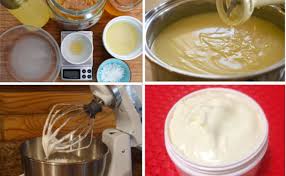
3.2 THE APPARATUS (TOOLS) NEEDED.
3.3 FLOW CHART
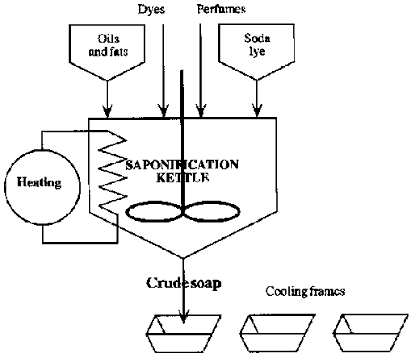
This is just an example, do your own flow chart.
3.4 METHOD OF PREPARATION.
Step2. 1kg of soda ash is put into a small container and 2litres of water was added into the small container containing soda ash and 1/2kg of sulphate was added to it then stir very well.
Then leave the two solution to stay for 24hrs.
Step3. On second day pour four litres of oil (p.k.o) into a big reactor and step1 solution then added small by small to have homogeneous mixture.
Step4. Step2 solution was added into the step3 in reactor and stirred very well to have homogeneous solution.
Step5. Colorant, perfume, and formaline were added into reactor in Step4 solution and stirred very well to have homogeneous mixture.
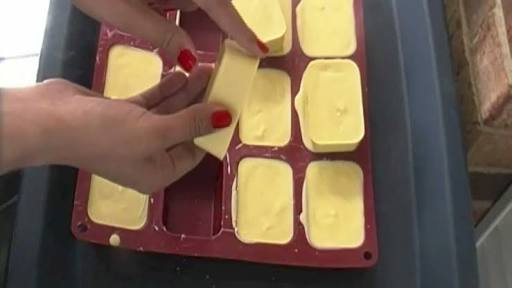
Step6. Prepared mould were made and the step5 solution was pour into it, covered and leave it to the next day to make it solid.
CHAPTER FOUR.
4.0 RESULT & OBSERVATION.
4.1 RESULT.
(adsbygoogle = window.adsbygoogle || []).push({});
The soap formed is a laundry soap with pure colour having a pleasant smell when the perfume is added to it.
It brings out the real colour that will added to the mixture and the present of the colour is to beautify it, and it does not affect or stain the clothes and utensils that we used it to wash.
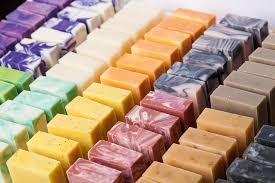
The soap comes out in a solid form with a good shape we want, accordingly to the types of soap we have, laundry (bar soap) has a very good form and shape which can be handle and used by everyone.
The soap was made into a smaller pieces of bar size.
When sodium or potassium soap are put into water containing calcium and magnesium ions (Hard water) results in formation of scum which appears grey appearance on the cloth. To achieve the same washing or cleaning action, more soap must be added.
4.2 OBSERVATION.
Proper stirring occurs during the mixing process.
When soap is shaken with water it becomes a soap solution that is colloidal in nature.
Agitating it tends to concentrate the solution on the surface and causes foaming. This helps the soap molecules make a uni-molecular film on the surface of water and to penetrate the fabric.
cleansing action of soap decreases in hard water. Hard water contains calcium and magnesium ions which react with sodium carbonate to produce insoluble carbonates of higher fatty acids.
When dissolved in water, it breaks dirt away from surface.
CHAPTER FIVE.
5.0 CONCLUSION AND RECOMMENDATION.
5.1 CONCLUSION.
(adsbygoogle = window.adsbygoogle || []).push({});
The soap was able to clean utensils properly leaving no grease on them and was found to be effective in washing white and coloured clothes.
It is amazing that the fundamentals of the soap making process are in essence uncharged over the cause of the past 2000years.
We use soap to get rid of all the dirt, grime and impurity especially from our skin, every other factor such as perfume etc is minor. The question which soap is best for us can be answered.
5.2 RECOMMENDATION.
– For Mothers and house wife who always desire to keep their kitchen and cooking utensils clean free from grease.
– For nursing mothers, for washing baby diapers since the soap does not permit scum precipitation as this will prevent rashes on their baby skin.
– For launderers and dry cleaners who desire to retain the confidence of their customers and as well gain more patronage.
– For maintenance companies, that desire to reduce their expenditures and minimize profit.
REFERENCES.
(adsbygoogle = window.adsbygoogle || []).push({});
Jones, geoffrey (2010) ”cleanliness and civilization.
Dunn kelvin M. (2010) scientific soap making the chemistry of cold process clavicular press ISBN 978-1-935653-09-0
Thomssen, E.G, PHD (1922). soap making manual free ebook at project Gutenberg.
Noted in levey martin (1958). Gypsum, salt and soda in the ancient mesopotamian chemical technology.
pears, francis (1859). the skin baths, bathing and soap the author pp 100- .
Robinson, james Harvey (1904). Reading in European history 1611 Ginnado.
Partington, james riddick (1999) A history of greek fire and gun powder. JHU press. p.307. ISBN 0-8018-5954-9.
Pliny the Elder, Natural history, xxviii. 191 alos martial Epigrammata viii 33,20.
Soap Etymonline.com. retrieved on 2011-11-20.
New school chemistry by Nicolas leblanc 2nd Edition 1790.
organic chemistry by John mc murry 2nd Edition.
(adsbygoogle = window.adsbygoogle || []).push({});
Biochemistry by mary k . campbell and shawn o. farrel 6th Edition Chapter 8 pg 203.
Advanced organic chemistry by Arun Bahl and B.S Bahl chapter 27 pg 659.
Kindly put down your project topic which you want our writers to work on, so we can post it very soon.
Or click on the link below to find from the list of topics we provided for you.
Top Post People are reading.
1. (10) WordPress Plugins for SEO.
2. How to Rank higher on Google.
3. Football betting tips, 100% sure.
4. African Fish Roll Preparation.
5. 10Fastest way to make Money with a Blog.
6. How to create smiley and icon.
7. How to send free SmS by Gmail.
8. Hustler Tools and Tips.
9. Promote yourself or business on Sharpest Arena.
10. How to Create a Blog.
11. How to Submit Sitemap to search engine, using webmasters.
12. 11Useful WhatsApp Tricks.